Thirty Days, One Outfit: I Killed My Morning Closet Crisis and Lived to Tell the Story
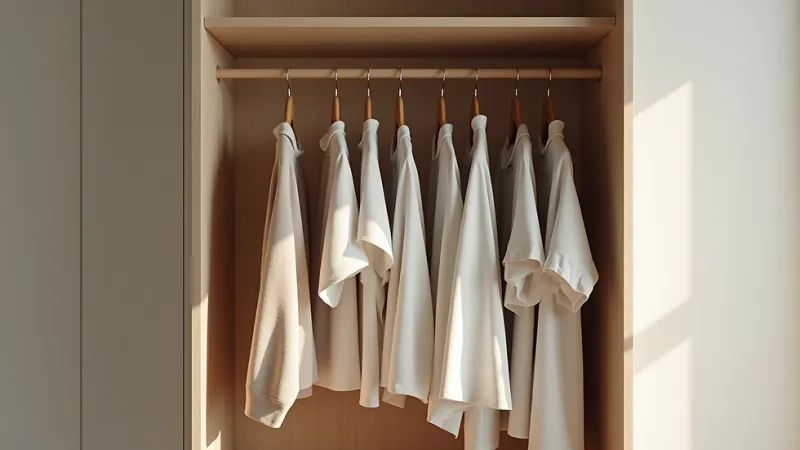
Photo: minimalist wardrobe single outfit hanging on hook neutral tones, via static.wixstatic.com
Day one felt like a dare. Day four felt like a religion.
For thirty consecutive days, I wore the same outfit to work: a charcoal merino wool dress, black leggings, and one pair of white leather sneakers I rotated with a pair of black ankle boots. I washed the dress every third night in the sink and hung it to dry. That's the whole experiment. No capsule, no rotation — one outfit, worn out into the world, over and over, while my coworkers watched.
The Math Nobody Tells You About
The average American spends somewhere in the neighborhood of seventeen minutes a day deciding what to wear, according to the various surveys that keep getting cited and never quite verified. Over a year, that's more than a hundred hours — four full days of standing in front of a mirror, sighing, saying "I have nothing to wear" while standing in front of several hundred things to wear.
The uniform deletes that entire category of decision. Not reduces it. Deletes it. By day six I noticed I was getting dressed in under a minute, and the mental bandwidth I got back went somewhere weird and good: I started making actual breakfast. I read a chapter of a book before work. My mornings went from a low-grade panic to something almost luxurious.
This is the Steve Jobs turtleneck logic, of course, but it's also the logic of judges in robes, surgeons in scrubs, and every Catholic school kid who ever got to homeroom three minutes early. Decision fatigue is real, and clothing decisions are decisions you pay for every single morning whether you want to or not.
The Social Experiment Nobody Signed Up For
Here's what actually surprised me: people noticed faster than I expected, and they reacted more personally than I expected.
By day nine, a coworker asked, half-joking, if I was "doing okay." By day fourteen, someone from another department referred to me as "the uniform girl" — affectionately, I think. My mother called to ask if I was depressed. I was not depressed. I was, for the first time in years, not thinking about clothes at all, which apparently reads as a crisis to the people around you.
I asked a few Americans who've gone longer-term with uniforms how they handled this. Dana, a software designer in Portland who's worn a rotation of three black shirts and gray trousers for two years, told me the comments lasted about a month. "After that, the outfit became part of me, like my glasses. Nobody comments on your glasses." Marcus, an attorney in Atlanta who wears the same navy suit five days a week, put it more bluntly: "Nobody has ever questioned a man in the same suit twice. The double standard is the experiment."
He's right. When I asked my coworkers to guess how many outfits I'd worn, three of them guessed "like, a few different ones, right?" The uniform worked partly because nobody was actually paying attention — which is its own quiet revelation about how much of our dressing is performance for an audience that isn't watching.
The Logistics, Honestly
Let's not romanticize it: one outfit for thirty days requires a garment that can handle it. Merino wool is the MVP here because it resists odor naturally. Avoid anything that wrinkles visibly, holds sweat, or shows wear after three washes. You will do more laundry than usual, just in smaller loads. You will want a second pair of shoes, because shoes are the pressure valve that keeps the whole thing from reading as a cult initiation.
The Low-Stakes Version
You don't need to go full monk. Try the workweek uniform instead: pick one outfit formula — not one garment — and wear it Monday through Friday for two weeks. Same silhouette, same colors, different clean pieces. A black tee and straight-leg jeans. A gray sweater and trousers. You get ninety percent of the mental benefit, zero of the "are you okay?" texts, and you'll learn something useful: which formula your body and life actually want, versus the fifteen formulas your closet keeps suggesting.
The point was never the outfit. The point was finding out how much of your day was quietly being spent on a decision you never agreed to make.