Same Shirt, Different Day: The Quiet Power of Dressing on Autopilot
There's a version of the personal uniform story that gets told over and over. It involves a black turtleneck, a dead billionaire, and the implication that genius requires simplicity. You know the one. And while that narrative isn't wrong exactly, it's also not the whole picture — and honestly, it's gotten a little tired.
The more interesting story? It's the one happening in apartments and suburbs and small towns all across the country, where regular people — teachers, nurses, graphic designers, parents of toddlers — quietly decided to stop reinventing themselves every morning. And found something unexpected on the other side.
Decision Fatigue Is Real, and Your Closet Is Making It Worse
By the time most of us have picked an outfit, we've already burned through a small but meaningful chunk of our daily mental energy. It sounds dramatic, but the research backs it up. The concept of decision fatigue — the idea that our capacity for good decision-making erodes with each choice we make — is well-documented in behavioral psychology. And while presidents and CEOs get credit for "solving" this problem with signature looks, the rest of us are standing in front of a closet full of clothes we don't love, running ten minutes late, feeling vaguely bad about ourselves before the day has even started.
A personal uniform sidesteps all of that. Not because it's fashionable (though it can be), and not because it signals productivity (though that's a nice side effect). It works because it removes a daily negotiation you never really wanted to have.
What a Uniform Actually Looks Like in Real Life
Here's where the concept gets more interesting than its reputation. A personal uniform isn't a costume or a gimmick. It's not about wearing the literal same shirt seven days a week (though if that's your thing, no judgment). It's about building a tight, coherent aesthetic that requires almost no thought to execute.
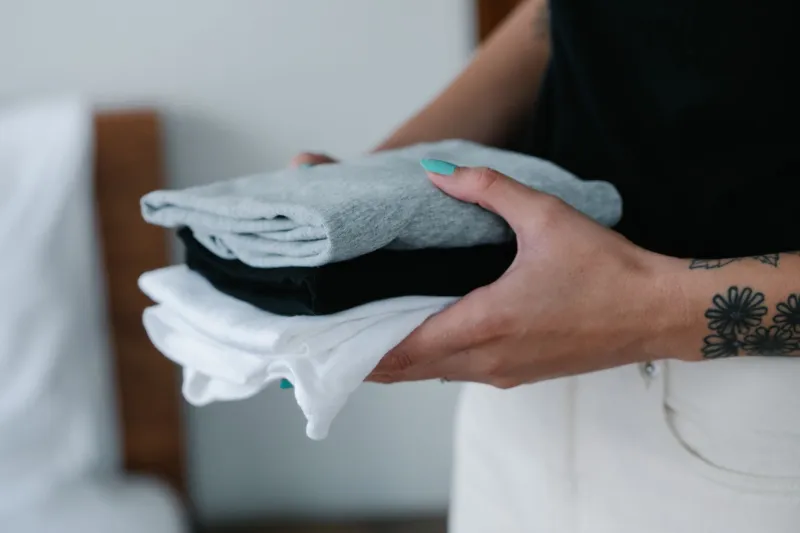
For some people, that looks like dark jeans, a white tee, and a clean sneaker — interchangeable pieces that always work together. For others, it's a rotation of linen trousers and fitted tanks in a single color palette. For others still, it's a dress silhouette they love in three different fabrics. The specifics don't matter as much as the principle: you've done the thinking ahead of time, so you don't have to do it again every single morning.
This is, quietly, one of the most minimalist things you can do with a wardrobe. You're not just buying less. You're deciding less. And that distinction matters.
The Identity Piece Nobody Talks About
There's a cultural pressure in the US — amplified by social media, by fast fashion's endless churn, by the way we've been taught to treat style as self-expression — to constantly evolve. To keep up. To show up differently, to stay interesting, to perform a version of yourself that's always fresh.
And for some people, that's genuinely joyful. Fashion as play is real and valid.
But for a lot of us, that pressure is exhausting and quietly corrosive. When your wardrobe is a moving target, you're never quite settled. There's always something missing, something outdated, something you'd wear if only you had it. You're perpetually in a state of wanting.
A uniform interrupts that loop. It says: this is who I am, and I've already figured it out. There's a surprising amount of confidence that comes from that kind of settled clarity. You stop walking into rooms wondering if you look right and start just… being in the room.
Psychologists sometimes call this "enclothed cognition" — the idea that what we wear influences how we think and feel about ourselves. When your clothes are consistent with your self-image, you feel more coherent. More like yourself. The uniform, counterintuitively, doesn't erase your identity. It reinforces it.
The Sustainability Angle (Because of Course There Is One)
Let's be direct about something: the personal uniform is one of the most naturally sustainable approaches to dressing that exists. Not because it's marketed that way, but because of what it structurally prevents.
When you know exactly what you wear, you stop impulse buying. You stop chasing trends. You stop getting seduced by a sale rack full of pieces that are technically cute but don't fit the life you actually live. You buy fewer things, you wear them more, and you replace them intentionally when they wear out — not because you got bored.
Cost per wear — that metric we've talked about before — naturally improves when you commit to a uniform. A $120 pair of trousers you wear three times a week for two years costs you less per use than a $40 pair you wore six times before they got pushed to the back of the closet. The math is simple. The uniform makes the math work in your favor almost automatically.
It also makes ethical shopping easier. When you know what you're looking for, you can take the time to find it from a brand whose practices you actually respect. You're not shopping in a panic or a mood. You're shopping with intention.
Starting Without Burning Everything Down
If you're intrigued but not ready to commit to a full uniform, that's fine. This doesn't have to be all-or-nothing.
Start by noticing what you actually reach for. Not what you think you should wear — what you actually put on when you're tired, running late, or just want to feel like yourself. Those pieces are your data. They're telling you something.
From there, ask yourself: what would it look like to have five more of this? Not five more things that are vaguely similar, but five more things that are genuinely interchangeable with what already works. That's the seed of a uniform.
You don't have to announce it. You don't have to make it a whole thing. You just start making choices that compound — gradually narrowing your wardrobe down to a version of itself that actually reflects you, rather than a collection of aspirations and impulse buys and gifts you felt guilty returning.
The Freedom on the Other Side
Here's what the people who've done this will tell you, if you ask them: it feels like putting something down you didn't realize you were carrying.
The mornings get quieter. The closet gets smaller and somehow more satisfying. You stop thinking about clothes all the time — which, paradoxically, means you start enjoying them more when you do. The pieces you have are the pieces you love. Nothing is wasted. Nothing is waiting to be worn.
That's the uniform effect. Not a productivity hack. Not a celebrity affectation. Just a quieter, more intentional way of showing up — wearing less, meaning more.