Ten Pieces, Zero Regrets: The Surprisingly Freeing Math Behind a Capsule Wardrobe
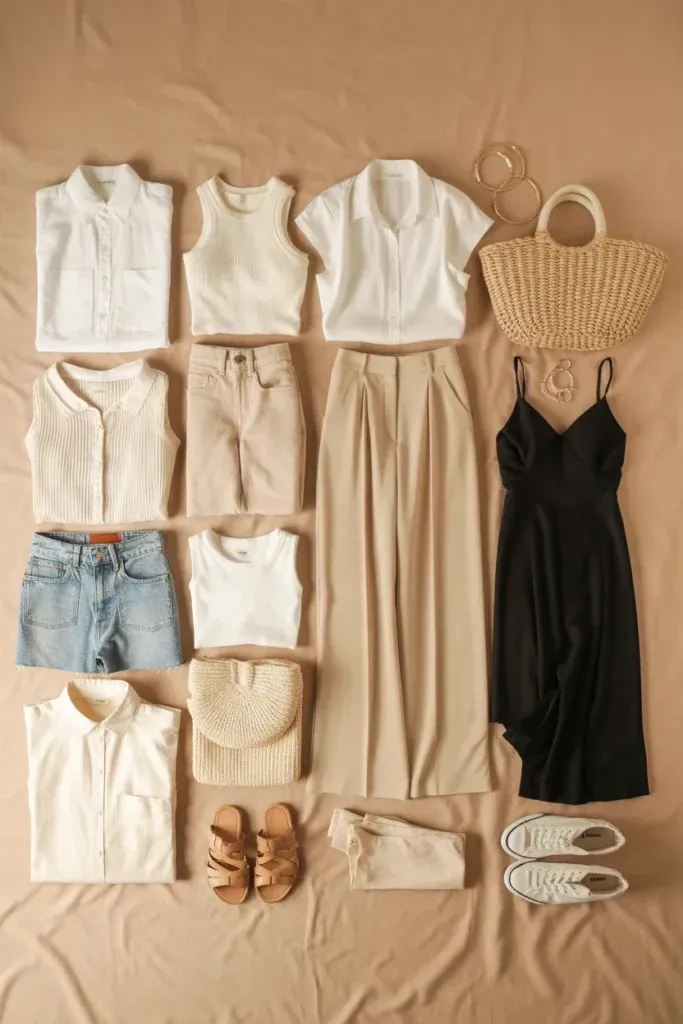
Photo: minimalist capsule wardrobe flat lay neutral tones folded clothing, via capsulewardrobestyle.com
Let's do some honest accounting. The average American woman owns 103 pieces of clothing — and wears roughly 10% of them on a regular basis. That means somewhere in your closet right now, about 90 items are quietly costing you money, space, and mental energy every single day without giving you anything back. That's not a wardrobe. That's a burden with a door on it.
At Folded & Co., we believe in wearing less and meaning more. And nowhere does that philosophy pay off more concretely than in the capsule wardrobe. Not the Instagram-aesthetic version with perfectly folded neutrals and a single candle on a shelf — but a real, functional, intentional collection of pieces that actually fit your life. Let's break down the math.
Your Brain Is Exhausted Before You Even Leave the House
Decision fatigue is real, and it starts the moment you open your closet. Psychologist Barry Schwartz coined the term "the paradox of choice" back in 2004, and the research has only gotten more robust since: the more options we have, the harder every single choice becomes, and the less satisfied we feel with whatever we pick.
A Columbia University study found that shoppers presented with 24 jam varieties were significantly less likely to buy — and less happy with their purchase — than those choosing from just six. Your closet works the same way. When you're staring down 80 options at 7 a.m., you're not curating an outfit. You're burning through willpower you need for the rest of your day.
Reducing your wardrobe to a deliberate core collection doesn't just simplify mornings. It fundamentally changes your relationship with getting dressed — from a daily source of low-grade stress into something that actually feels good.
What "10 Pieces" Actually Means (It's More Flexible Than You Think)
The number ten is a starting point, not a mandate. The goal is a core wardrobe of versatile, high-quality essentials that can be mixed, layered, and styled across multiple contexts — work, weekends, dinners out, casual Fridays, whatever your life actually looks like.
A solid capsule foundation might include:
- 2 well-fitting bottoms (one casual, one elevated — dark jeans and tailored trousers, for example)
- 3 tops that work across contexts (a classic tee, a relaxed button-down, and one slightly dressier option)
- 1 versatile dress or jumpsuit that transitions from day to evening
- 1 layer — a structured blazer, an oversized linen shirt, or a clean-lined cardigan
- 1 outerwear piece suited to your climate
- 2 pairs of shoes — one casual, one that can carry you into a meeting or a dinner
Notice what's not on that list: anything that only works one way. Capsule dressing is about multiplying options through intentionality, not shrinking your style personality.
The Closet Audit: A Step-by-Step Framework That Doesn't Require a Weekend
You don't need to rip everything out of your closet at once. A realistic audit takes about two hours spread across a week.
Step 1: The Honesty Pile Go through everything you own and pull out anything you haven't worn in the last 12 months. No exceptions for sentimental value yet — just separate it. You're not throwing it away, just getting honest about what's actually in rotation.
Step 2: The Cost-Per-Wear Calculation For each remaining item, do a quick mental calculation: what did it cost, and roughly how many times have you worn it? A $200 blazer you've worn 40 times costs $5 per wear. A $35 trendy top you've worn twice costs $17.50 per wear. This reframes the "but it was cheap" justification that drives most closet clutter.
Step 3: The Versatility Test Ask yourself: can this item work in at least three different outfits with things I already own? If the answer is no, it's a candidate for removal — or a signal that you're missing a foundational piece it would pair with.
Step 4: The Feel-Good Filter Does it fit right now, today? Does it reflect who you actually are, not who you were two years ago or hope to be someday? Clothes that don't fit or don't feel like you are just guilt hanging on a hanger.
The Real Numbers: What Fewer, Better Pieces Actually Save
Here's where the math gets genuinely interesting. The average American spends about $1,700 a year on clothing. Research from ThredUp and various sustainability organizations consistently shows that fast fashion purchases — the impulse buys, the trend-chasing pieces, the "it was only $20" decisions — make up the majority of that spending while delivering the least value per wear.
When you shift to intentional buying — fewer pieces, higher quality, more deliberate choices — spending typically drops by 30–50% within the first year, even when individual item prices go up. Because you stop buying things you don't need. Because you stop replacing cheaply made pieces every six months. Because you finally know what you actually wear.
The time savings are just as significant. Studies on decision fatigue suggest that simplifying routine choices — like what to wear — can recover up to 30 minutes of productive mental energy per day. Over a year, that's roughly 180 hours. What would you do with an extra 180 hours?
Minimalism Isn't Deprivation. It's Clarity.
Here's the reframe that changes everything: building a capsule wardrobe isn't about punishing yourself or giving things up. It's about getting radically clear on what actually works for you — and then making sure your closet reflects that clarity instead of contradicting it.
You're not wearing less because you care less. You're wearing less because you've decided that what you keep is going to mean something. Every piece earns its place. Every morning gets easier. Every dollar you spend goes further.
At Folded & Co., we design with exactly this intention — pieces built to live in your core rotation for years, not seasons. Because a wardrobe that works isn't measured in quantity. It's measured in how confidently you walk out the door.
Start with ten. See how it feels. We think you'll be surprised how much more you have when you stop settling for less.